
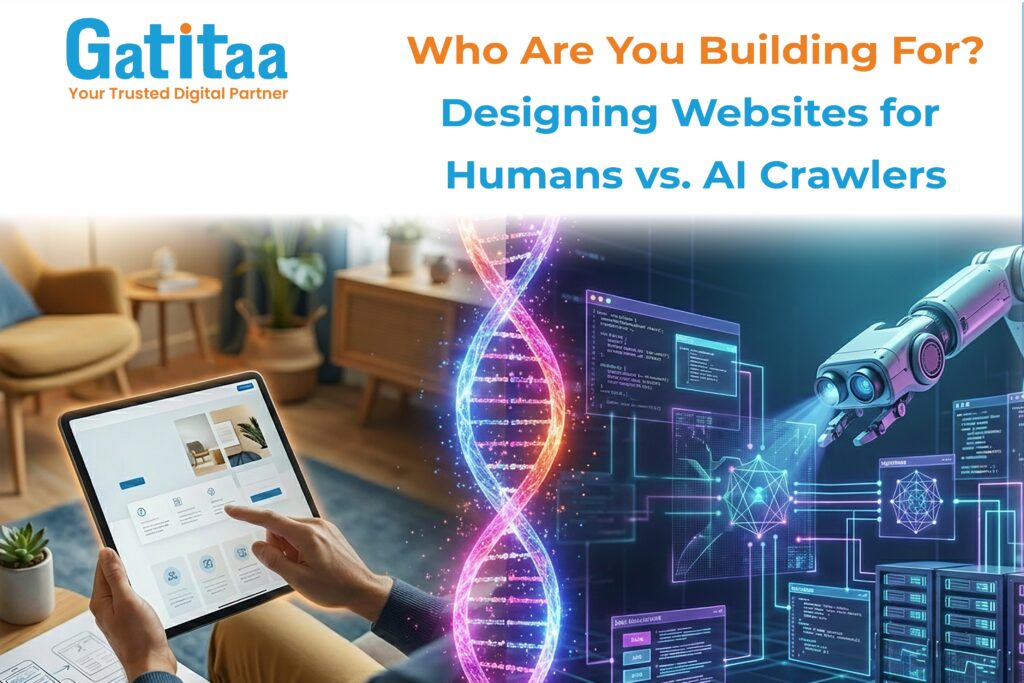
Who Are You Building For? Designing Websites for Humans vs. AI Crawlers
As the year 2026 rolled in, web design was already completely transformed. An entire era of Generative Engine Optimisation (GEO) and LLM Optimisation is witnessing this transformation. Henceforth, websites would need to satisfy both human visitors and AI agents, who are the ones that crawl, read, and summarise the content for users. The brands have now started learning to live in a hybrid web, which will necessitate proper planning, architecture, and content strategy to create a pleasant user experience as well as a pleasant bot experience.
The Hybrid Web: Balancing Humans and Machines
Websites today aim at two different target groups: the humans who use them to browse, click and make a purchase, and the AI crawlers that index, interpret and summarise the website’s content. Putting all the effort into gaining the attention of users only by the aesthetics can lead to the website being completely ignored by AI-powered search and voice assistants; on the other hand, making it too compatible with machines can lead to the real users being left out. The task in front of the web development companies and UI/UX design agencies is to come up with a solution that is satisfactory for both sides – captivating people and at the same time being machine-readable!
Architecture vs. Aesthetic
Technically, the structure of a site is now as significant as its visual attractiveness. The use of Smart content flow, semantic HTML, and structured data is necessary for AI programs to comprehend your website. At the same time, a layout that is clean and easy to use, a design that adapts to all devices, and an attractive user interface still play a major role in capturing human attention. Striking this balance makes sure that your website is not only easily found in AI-driven searches but also user-friendly and off-brand at the same time.
Smart Content for an Agentic Experience
Content necessitates two-fold optimisation nowadays: one is the human-readable text that straightforwardly tells your brand story, and the other is the machine-readable metadata, headings, and contextual clues for AI understanding. The concept of smart content comes here. Content can be made AI-readable by using short paragraphs, bullet points, and clear labelling, while still preserving the flow of the story, the tone, and the visual clues that would keep human visitors interested.
The emergence of AI agents brings along the agentic experience, whereby websites should be ready for the questions to be raised by AI apps and voice helpers. Structured replies that can be reused by these systems are to be given. This method not only facilitates finding your content but also guarantees that your content is correctly represented in the AI-generated replies.
FAQs
Certainly not, in case it is properly performed. Human-centred design must be the one to decide on the aesthetics, layout, and interactive features. AI optimisation goes mainly over the underlying structure, metadata, and content clarity—not the visual experience.
Utilise tools, such as structured data validators, AI content analysers, or AI prompt assistants, to provide summaries for your web pages. If the AI is capable of pinpointing the main ideas with precision, it means that your website is machine-readable and optimised.
Structured data (Schema.org) implementation and HTML semantics are required for all pages. This means that AI bots can read the content accurately and, at the same time, the content will be more visible in AI-generated search results.
- What Happens When AIs Start Talking to Each Other?
- Multilingual SEO: Rank in Any Language with Voice Search
- How Do I Get My Brand Mentioned in Gemini and ChatGPT’s Daily Summaries?
- Convert Your WhatsApp Enquiries: The 2026 Sales Funnel That Actually Sells
- Why Swiggy and Zomato Are Moving Toward “Quiet Marketing”
- Visual SEO: Why Your Product’s Physical Packaging is Your New Homepage
- Are Third-Party Cookies Officially Dead in 2026?
- Who Are You Building For? Designing Websites for Humans vs. AI Crawlers
- Employee-Generated Content (EGC): Why Your Staff is Your Best Ad Agency
- YouTube Shorts vs. Instagram Shop: Where Should You Launch in India in 2026?
- The 2026 Marketing Budget Breakdown: Where to Spend vs. Where to Save
- RIP SEO? Why 2026 Is the Year of GEO
- The Rise of ‘Vibe’ Marketing: Why Gen Z Is Ignoring Your Polished Ads
- Why does small business need a strong brand identity in the digital age?
- SEO-Friendly Website Design That Ranks and Converts
One Response