
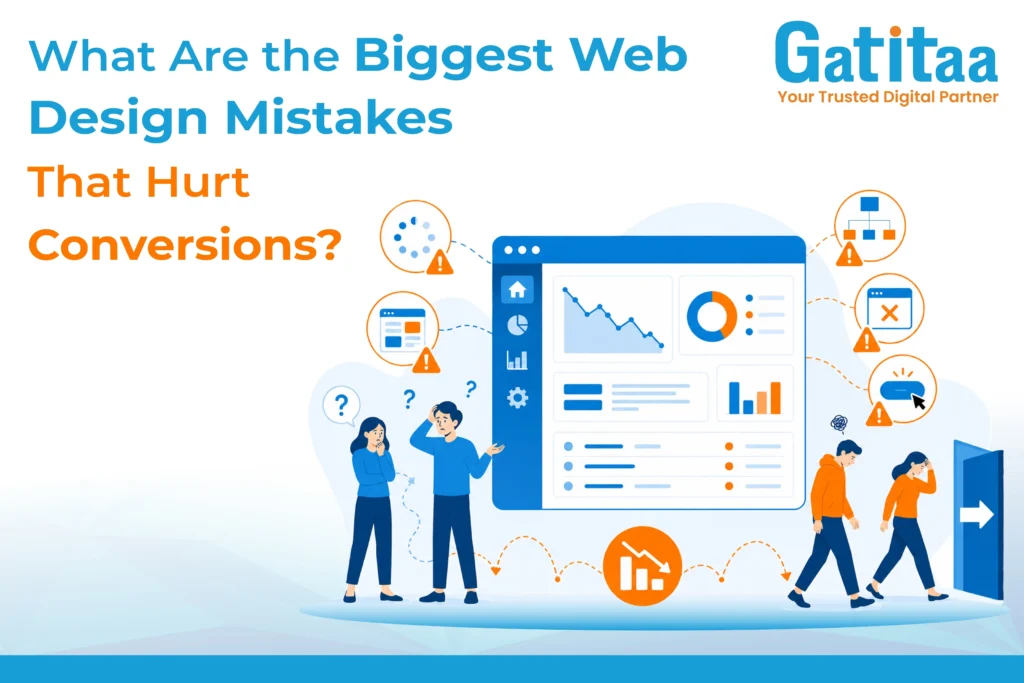
A website serves as the initial point of contact between users and a brand, and even minor design errors will create major trust problems while decreasing conversion rates. The design errors which businesses make on their websites result in lost potential customers because their web design mistakes that hurt conversions results despite having excellent products and services.
Web Design Mistakes That Hurt Conversions
One of the most common website design mistakes is cluttered layouts that confuse users instead of guiding them. The combination of poor navigation, slow loading speed, unclear call-to-action (CTA) buttons and inconsistent branding leads to increased bounce rates. The main problem arises from mobile optimization neglect, which results in a bad user experience for smartphone users. The common UX mistakes on websites lead to decreased user engagement and stop users from completing tasks such as sign-ups and purchases.
Why Do Web Design Mistakes Impact Conversions?
Web design directly affects user trust and behaviour. When users land on a poorly designed site, they struggle to find information, which creates frustration. This leads to higher drop-off rates and lower conversion performance. In fact, even small bad web design examples, like hard-to-read fonts or confusing menus, can make users leave within seconds. A smooth and intuitive design builds confidence, while a poor design breaks it instantly.
Most Common Web Design Mistakes Designers Do
Many designers unintentionally make mistakes that reduce website performance and conversions. The errors that designers make through their work activities affect three fundamental aspects of user experience. The list of most frequent issues includes the following problems:
- Overusing animations that slow down performance
- Ignoring mobile responsiveness
- Poorly placed or unclear call-to-action buttons
- Cluttered layouts with too many elements
- Not optimizing page loading speed
- Weak or confusing navigation structure
The web design mistakes to avoid for better conversions, which should not be performed, should be avoided because they affect user interactions with a website while using the website to achieve specific goals.
How Can I Improve My Website’s Conversion Rate?
You need to create a website that users can navigate easily while maintaining high speed and displaying direct calls to action and a compatible mobile display. Your design process should start with A/B testing to study user behaviour, which will help you make data-driven design improvements. The user journey needs friction reduction because it represents the main method to boost conversion rates.
Conclusion
Business success depends on businesses that need to eliminate web design mistakes that hurt conversions. Good design is not just about visuals, it’s about usability, clarity, and user experience. Businesses can achieve better customer engagement through their websites by removing typical UX mistakes and creating designs that work well on mobile devices and drive conversions.
FAQs
A poor design creates confusion, reduces trust, causes high bounce rates, and therefore leading to fewer conversions.
As a result, nonresponsive designs could leave one without an audience.
Improve speed, simplify navigation, optimize CTAs, and ensure a clean, user-friendly layout.
Recent Blog
- Zero-Click Search Is Stealing Your Traffic: Here Is How to Win It Back
- 5 AI Tools That Will Double Your Marketing ROI
- How to Prepare Your Marketing Strategy Before Google Completely Changes Search
- Why AI Search Engines Are Mentioning Your Competitors, Not You!
- Why Your Paid Ad Campaigns Will Cost Double This Year (Unless You Pivot Now)
- Why Are High Google Rankings Suddenly Driving Zero Clicks?
- What is AEO (Answer Engine Optimization) and How is it Different from SEO?
- How to Develop Authentic Brand Messaging in the Age of Generative AI
- Why Single-Camera Forces Better Storytelling in Commercials
- Why Human Content Still Outranks AI in 2026
- 2026 Web Design Trends: Organic Layouts, Motion Narratives & the Anti-AI Backlash Explained
- How AI Video Is Killing Traditional Editing in 2026 — And What Comes Next
- What Happens When AIs Start Talking to Each Other?
- How Do I Get My Brand Mentioned in Gemini and ChatGPT’s Daily Summaries?
- Multilingual SEO: Rank in Any Language with Voice Search
- Convert Your WhatsApp Enquiries: The 2026 Sales Funnel That Actually Sells
- Why Swiggy and Zomato Are Moving Toward “Quiet Marketing”
- Visual SEO: Why Your Product’s Physical Packaging is Your New Homepage
- Are Third-Party Cookies Officially Dead in 2026?
- Who Are You Building For? Designing Websites for Humans vs. AI Crawlers
- Employee-Generated Content (EGC): Why Your Staff is Your Best Ad Agency
- YouTube Shorts vs. Instagram Shop: Where Should You Launch in India in 2026?
- The 2026 Marketing Budget Breakdown: Where to Spend vs. Where to Save
- RIP SEO? Why 2026 Is the Year of GEO
- The Rise of ‘Vibe’ Marketing: Why Gen Z Is Ignoring Your Polished Ads
- Why does small business need a strong brand identity in the digital age?
- SEO-Friendly Website Design That Ranks and Converts